AI Legal Insights

Stay updated on the latest trends, cases, and media highlights

Media Coverage & Press Releases

LegalSign SaaS coverage image

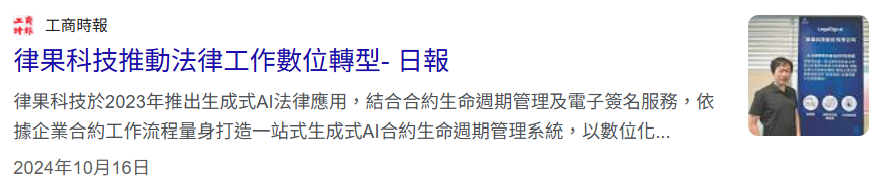
LegalSign focuses on solving legal affairs with AI technology. Its flagship platform LegalSign.ai integrates contract lifecycle management, generative AI, and electronic signatures to help businesses improve efficiency and reduce risk, earning multiple innovation awards.

Read article
LegalSign SaaS coverage image

LegalSign launched its cloud SaaS "LegalSign," digitizing the entire process from contract drafting to signing, with the potential to improve signing efficiency by 85%, ensuring contracts are no longer a bottleneck for transactions.

Read article
LegalSign SaaS coverage image

LegalSign CEO Chi-Tung Chen possesses a cross-disciplinary background in mechanical engineering, Chinese literature, and law. By combining legal and technology expertise, he leads the team in developing innovative legal tech products to uncover industry pain points and business opportunities.

Read article
LegalSign SaaS coverage image

Embracing the AI era, the Ministry of Economic Affairs recently reviewed the first batch of NVIDIA TAIPEI-1 computing power applications, ultimately approving four team proposals, including LegalSign.

Read article
LegalSign SaaS coverage image

Chunghwa Telecom's 5G Accelerator has been an important incubation platform for Taiwan's startup industry since its launch in 2018. This year's eight selected startups include LegalSign.

Read article
LegalSign SaaS coverage image

Chi-Tung Chen shared how generative AI combined with legal work achieves 80-90% accuracy in contract first drafts, significantly reducing time and costs. RAG technology is used to address AI hallucination issues and drive legal digital transformation.

Read article
LegalSign SaaS coverage image

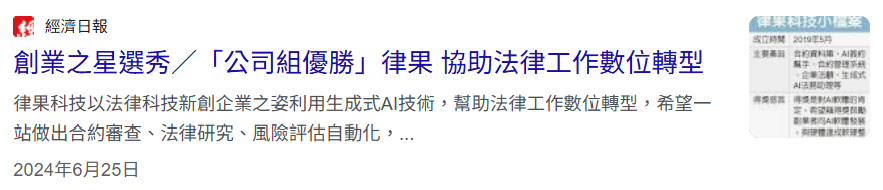
LegalSign uses generative AI and one-stop contract services to help businesses automate contract review, legal research, and risk assessment, driving legal digital transformation and securing National Development Fund investment.

Read article
LegalSign SaaS coverage image

LegalSign developed the world's only LLM model capable of passing Taiwan's bar exam, combining AI with legal expertise to promote intelligent legal work and gaining adoption by multiple enterprises.

Read article
LegalSign SaaS coverage image

LegalSign uses generative AI technology to assist in digital transformation of legal work, automating contract review, legal research, and risk assessment, and was selected as a winner in the Startup Star Competition.

Read article
LegalSign SaaS coverage image
How did Taiwan startup LegalSign successfully launch?

With the help of NTU Entrepreneurship Center, LegalSign established a partnership with Acer, integrating AI to improve enterprise contract management processes and breaking through market awareness barriers.

Read article
LegalSign SaaS coverage image

When ChatGPT is combined with legal applications, it can become a virtual legal officer, helping individuals or small businesses optimize legal work, and serving as a dedicated assistant for corporate legal professionals — and this is the new product from legal tech startup "LegalSign."

Read article
LegalSign SaaS coverage image

The revision of the Electronic Signatures Act marks a new milestone in Taiwan's digital economy development, promoting electronic signature adoption and application, enhancing document signing security and legal effectiveness, and significantly improving operational efficiency across industries.

Read article
LegalSign SaaS coverage image

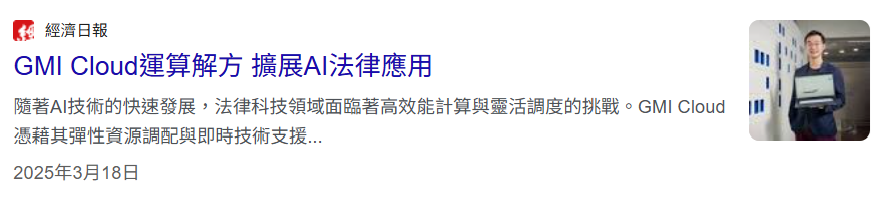
GMI Cloud computing solutions expand AI legal applications, utilizing distributed computing architecture to help LegalSign effectively control costs, improve efficiency and compliance.

Read article
LegalSign SaaS coverage image

Chi-Tung Chen stated that Project TAME has become the world's only language model capable of passing Taiwan's bar exam first stage (multiple choice), achieving a score that surpasses 89% of test takers.

Read article
LegalSign SaaS coverage image

Built jointly by Changchun Group, Pegatron, Chang Gung Hospital, Unimicron, TechOrange, AI-focused legal tech company LegalSign, NTU CSIE, and NTU MIS, based on the Llama-3 70B model, trained with 500 billion tokens.

Read article
LegalSign SaaS coverage image

LegalSign LegalTech is a law-based technology startup focused on legal affairs. Its flagship product LegalSign.ai, as the name implies, combines AI, law, and technology. The team is dedicated to applying technology to solve legal affairs, providing a "one-stop generative AI legal application + contract lifecycle management + electronic signature platform."

Read article

Case Studies & Success Stories

Harvey AI: A Case Study in Leading Legal Service Digital Transformation

Harvey AI is one of the most notable innovative enterprises in the legal tech field in recent years, successfully combining generative artificial intelligence with legal expertise to provide unprecedented work transformation opportunities for global law firms and legal departments. Since its co-founding in 2022 by former O'Melveny & Myers attorney Winston Weinberg and former Google DeepMind researcher Gabriel Pereyra, Harvey AI has rapidly attracted industry attention and within just a few years has been implemented across multiple top-tier global law firms and large enterprises, becoming a key driver in modernizing legal services.

Harvey AI's product core lies in providing an AI platform designed specifically for the legal field, with main modules including Harvey Assistant (natural language legal assistant), Vault (large-scale document storage and semantic analysis), Knowledge (knowledge management system), and Workflows (automation workflow engine). These tools support the entire workflow from legal research, contract review, compliance checks, case preparation, to litigation strategy analysis, significantly reducing the time lawyers spend on tedious tasks.

Among these, Harvey Assistant is the most commonly used module by lawyers, allowing direct natural language queries to obtain instant legal research results, draft contract clauses, and analytical opinions. Assistant can generate compliant content based on different jurisdictional requirements, with attached case law and statute sources to ensure professional accuracy. Vault supports high-speed analysis of over 10,000 documents, automatically extracting keywords and risk factors, saving law firms significant manpower costs in preliminary document screening.

Harvey's underlying technology is built on GPT-4 with vertical fine-tuning for the legal domain, covering case law, regulations, contract samples, and practice commentaries, making it more accurately capable of understanding legal context compared to general AI models. Harvey's legal AI model provides complete citation sources and supports customized training and private deployment, meeting the high-specification requirements for confidential data and proprietary systems in the legal industry.

One notable success story comes from UK top-tier law firm Allen & Overy. The firm began internal pilot testing of Harvey AI in November 2022 and officially rolled out the platform across 43 global offices and 3,500 lawyers in February 2023. During the pilot period, over 40,000 queries were submitted, covering legal research, due diligence, contract drafting, and clause comparison scenarios. The firm's innovation director David Wakeling commented: "I've been in legal tech for 15 years and have never seen a game-changing tool like Harvey."

Beyond Allen & Overy, US-based Paul Weiss and Ireland's A&L Goodbody have also adopted Harvey AI. While Paul Weiss maintains reservations about efficiency improvements, they still recognize AI as a powerful tool for preliminary analysis of large volumes of data, helping lawyers focus their attention on high-value decisions.

In corporate legal departments, PwC, one of the Big Four accounting firms, also deployed Harvey AI in Singapore in 2024, applying it to contract analysis and regulatory interpretation. That same month, renowned Singapore law firm WongPartnership became the first firm in Southeast Asia to deploy the Harvey platform, demonstrating its successful entry into the Asian professional services market.

Harvey AI's business model centers on enterprise-grade SaaS, not offering individual user services, but instead connecting directly with law firms and enterprises through a "Request a Demo" mechanism. The pricing model is annual or quarterly subscription-based, with customized packages based on user count and module selection. For example, contract-intensive clients may prioritize Vault and Workflows; litigation-focused clients prefer Assistant and knowledge modules.

As of 2025, Harvey AI's annual recurring revenue (ARR) has exceeded US$75 million and continues to expand to multinational large law firms. Its investors include OpenAI Startup Fund, Sequoia Capital, Kleiner Perkins, GV (Google Ventures), and other prominent institutions. After Series C funding, its valuation reached US$1.5 billion, and in early 2025, Series D further raised the valuation to US$3 billion, making it a super unicorn in the legal AI space.

Harvey's product continues to evolve. Starting in 2025, the platform supports multi-model architecture — beyond the original OpenAI GPT-4 base, it also integrates Anthropic's Claude and Google's PaLM 2 models, allowing clients to choose the most suitable model based on preference and jurisdictional characteristics. Additionally, Harvey on Azure mode supports enterprise deployment in their own cloud environments, enhancing data governance capabilities.

Harvey AI's growth strategy includes aggressive international market expansion and recruitment of legal-background talent. By the end of 2024, the team will reach 160 people, with most product and marketing members possessing international law firm experience, such as former attorneys from Skadden, White & Case, and Paul Weiss, strengthening professional dialogue capabilities with clients.

Regarding Chinese legal support, Harvey has not yet conducted specialized training on Chinese legal corpus. While it can handle basic Chinese queries and document analysis, its precision and professionalism remain primarily focused on English common law systems. Nevertheless, its multilingual capabilities and open architecture provide potential for future Chinese market expansion, potentially through partnerships with local players to build Chinese-specialized models.

In summary, Harvey AI demonstrates the feasibility and effectiveness of implementing generative AI in the legal industry. Through partnerships with top global law firms, continuous investment in specialized model training and cybersecurity design, it brings profound transformation to the legal services industry. Its commercial success also proves that when AI technology is deeply integrated into professional workflows, it not only unleashes productivity but may also reshape industry division of labor and competitive landscape.

The Harvey AI case can be seen as a paradigm of legal-technology convergence, not only bringing significant efficiency innovation to large law firms and enterprises, but also providing a referenceable empirical model for global legal AI development.

Latest Articles & AI Legal Tech Trends

(Content coming soon, please stay tuned)